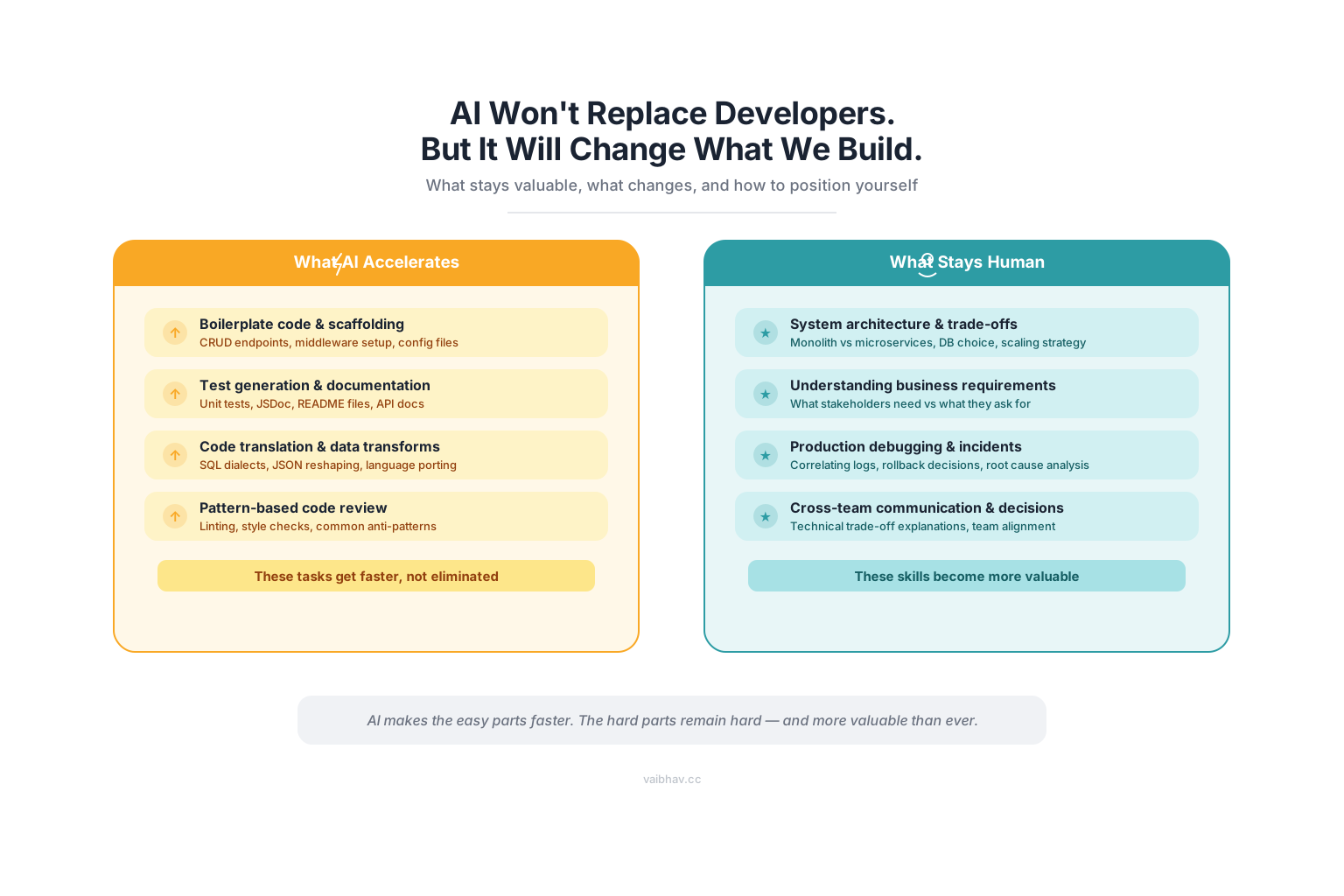
AI makes the easy parts of software development faster.
The hard parts remain hard.
Every week there is a new headline: "AI will replace 80% of software developers" or "coding is dead." Meanwhile, every company I talk to is still hiring developers and struggling to find good ones. Both things cannot be equally true. So what is actually happening?
I use AI tools every day. GitHub Copilot, Claude, ChatGPT, LLM-powered code review. They have genuinely changed how fast I write boilerplate, generate tests, and prototype ideas. But the work that takes most of my time at CloudFountain, the work that actually determines whether a project succeeds or fails, has not changed at all.
What AI Actually Automates (And It Is Real)
Let me be honest: AI tools are not hype. They are genuinely useful for a specific category of development work.
Setting up a new Express server with middleware, creating CRUD endpoints, writing CSS for a standard layout: these tasks that used to take hours now take minutes. AI handles them well because the patterns are well-established and the correctness criteria are clear. This is a real productivity gain.
Generating unit tests for existing functions, writing JSDoc comments, creating README files. AI is excellent at this because the input (the code) and the expected output (tests that cover it) are well-defined. I generate first drafts of tests with AI and then review and adjust. It is faster than writing from scratch.
Converting a SQL query to a different dialect, transforming JSON structures, rewriting a function from JavaScript to Python. Pattern matching across well-documented languages is where AI shines.
What AI Cannot Do (And Probably Will Not Soon)
Here is where the "replace developers" narrative falls apart. The tasks that consume most of a senior developer's time are not coding tasks.
The hardest part of software development has never been typing code. It is figuring out what the code should do. Translating a vague business requirement into a technical specification. Recognizing when what the stakeholder is asking for is not what they actually need. Navigating competing priorities between product, design, and engineering. No AI tool does this because it requires understanding context that exists in conversations, organizational politics, and unstated assumptions.
Should this be a monolith or microservices? Should we use DynamoDB or RDS? How do we handle the fact that our payment provider's webhook is unreliable? These decisions depend on constraints that AI does not have access to: team size, budget, deployment environment, existing technical debt, and the skills of the people who will maintain this system for the next three years. Architecture is about trade-offs, and trade-offs require judgment about things that are not in the codebase.
At 2 AM when the analytics dashboard is showing stale data and the SageMaker endpoint is returning 500s, no AI tool is triaging the problem. Debugging production issues requires correlating logs across services, understanding deployment history, knowing which recent change is most likely to have caused the regression, and making judgment calls about whether to roll back or fix forward. This is experience and systems thinking, not pattern matching.
How to Position Yourself (Instead of Panicking)
The developers who will struggle are not the ones who refuse to use AI. They are the ones whose entire value proposition is writing code that AI can also write. If your job is exclusively translating well-defined specifications into boilerplate code, yes, that work is getting automated. But if that describes your entire job, the problem is not AI. The problem is that you are not growing.
Use AI to handle the implementation details faster, and spend the freed-up time on the things AI cannot do: understanding business domains, designing systems, making architectural decisions, and communicating trade-offs to non-technical stakeholders. The developers who use AI to write code faster and then use the extra time to do more coding are missing the point. Use the extra time to do the work that AI cannot.
The most valuable skill in 2025 is not "can use Copilot." It is "can build AI-powered features into products." Understanding how LLMs work, when RAG is appropriate, how to evaluate model outputs, and how to deploy ML systems in production. These are engineering skills that are in high demand and will remain so. The companies hiring are not looking for developers who use AI as a typing assistant. They are looking for developers who can build AI into the product.
Communication. System design. Cross-team collaboration. Production reliability. Understanding business context. Mentoring other developers. These are the skills that make senior developers valuable, and they are exactly the skills that AI is worst at. The career path for developers has not changed: become the person who can be trusted with increasingly complex and ambiguous problems. AI just raises the floor of what "complex" means.
The Honest Take
AI is the most significant productivity tool for software development since the IDE. It will change what a typical day looks like for developers. Some categories of work will become much faster. Some roles that exist purely to do rote implementation will shrink. That is real and worth taking seriously.
But the core of what makes a software developer valuable, the ability to understand problems, design solutions, build reliable systems, and work with humans to deliver products, is not going anywhere. If anything, as AI handles more of the routine work, the developers who can do the hard parts become more valuable, not less.
The future belongs to developers who use AI as a tool and invest in the skills that AI cannot replicate: judgment, context, and the ability to build things that matter.