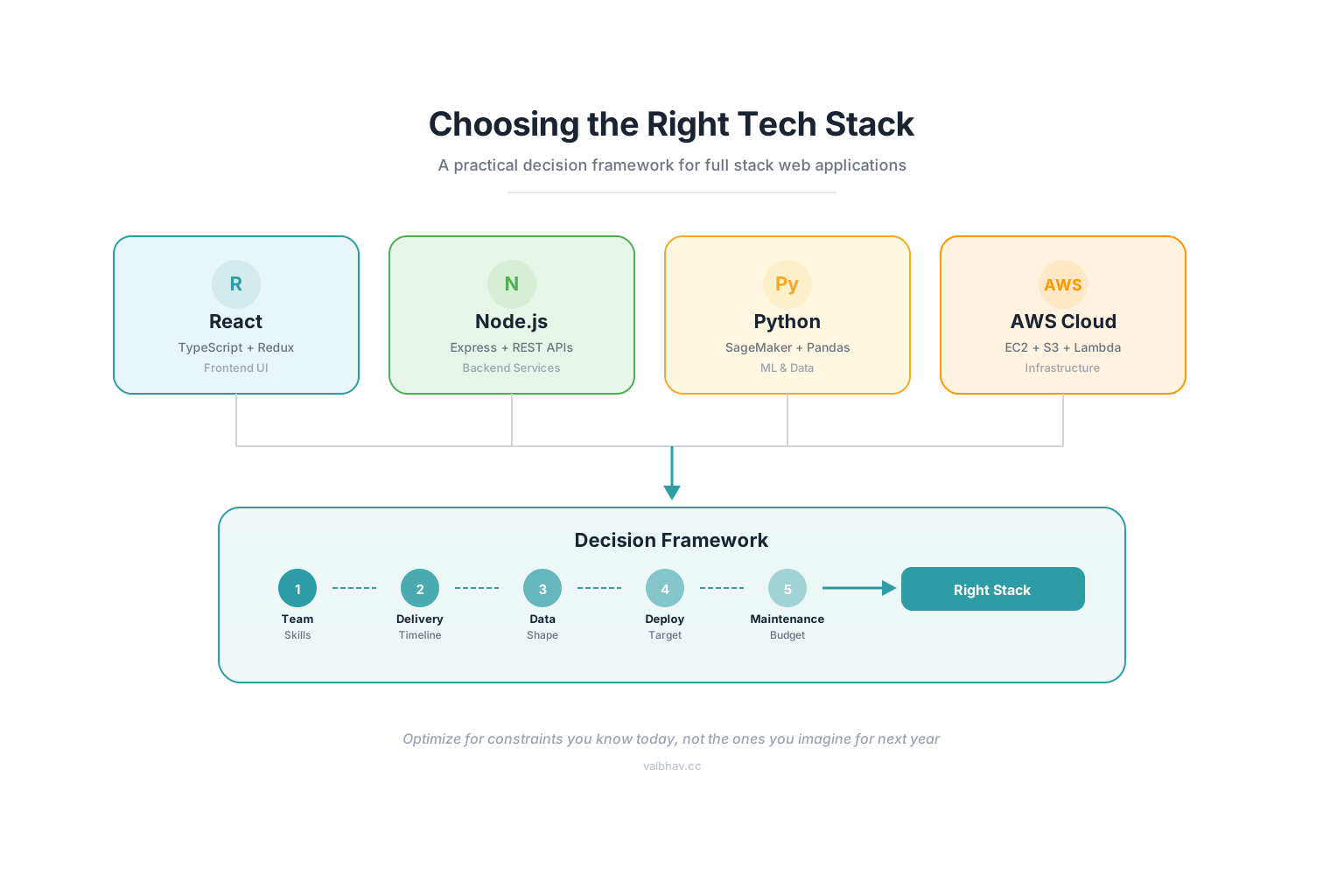
The best tech stack is the one your team
can ship and maintain in production.
Every new project starts with the same question: what should we build this with? After leading full stack development at CloudFountain and building products at VANtage and Aspire, I have shipped production applications in React, Node.js, Python, PHP, Java, and several combinations in between. The choice has never been about which technology is "best." It is about which one fits the constraints.
Here is the framework I use. It is not theoretical. Every criterion comes from a project where choosing differently would have saved time or prevented problems.
Start with the Delivery Timeline
If you have four weeks to ship an MVP, that eliminates most "interesting" choices. You need a stack your team already knows. For most of the projects I lead, that means React on the frontend with Node.js and Express on the backend. The ecosystem is mature, hiring is straightforward, and the deployment story on AWS is well documented.
If you have a longer runway and the project involves heavy data processing or ML workflows, Python becomes the natural backend choice. At CloudFountain, our lead scoring models run on AWS SageMaker with Python preprocessing pipelines, while the dashboard that consumes those predictions is a React and Node.js application. Mixing stacks is not a problem when the boundaries are clean.
Match the Database to the Access Pattern
For most web applications, a relational database like MySQL or AWS RDS is the right default. Your data almost certainly has relationships. ORMs work well. Migrations are mature. I reach for MongoDB or DynamoDB when the access pattern genuinely benefits from it: high-throughput key-value lookups, document-shaped data with no cross-references, or when DynamoDB's managed scaling eliminates operational overhead that the team cannot afford.
If you know the product will need complex filtering, aggregation, or reporting, start with a relational database. Retrofitting analytical queries onto a NoSQL store is painful. At CloudFountain, our analytics platform pulls from MySQL and Google Analytics because the reporting requirements demanded joins, date-range aggregations, and pivot-style queries that would have been expensive to implement on DynamoDB.
Frontend: React Is Still the Practical Default
React has its critics, and many of the criticisms are valid. But for a full stack developer leading a team in 2025, the practical argument is strong: the hiring pool is large, the component ecosystem is massive, and the tooling around testing (Jest, Cypress) and deployment is well-established.
I use TypeScript on every new React project now. The upfront cost is small and the payoff in reduced runtime errors and better IDE support is significant, especially when multiple developers are working on the same codebase.
Cloud Architecture: AWS for Most, but Keep It Simple
Most of the projects I work on run on AWS. The services I reach for most often: EC2 or ECS for compute, S3 for storage, RDS for databases, Lambda for event-driven tasks, API Gateway for managed endpoints, and CodePipeline for CI/CD.
It is tempting to adopt every managed service AWS offers. In practice, each additional service adds operational surface area: monitoring, IAM policies, cost management, and debugging. For a typical web application, a load-balanced EC2 or ECS setup with RDS and S3 covers 90% of needs. Add Lambda and SQS when you genuinely need async processing, not because the architecture diagram looks impressive.
The Decision Matrix I Actually Use
When a new project lands on my desk, I walk through these questions in order:
1. What does the team know? The best technology your team cannot maintain is worse than the second-best technology they can. 2. What is the deployment target? If the client is already on AWS, you pick AWS-native services. If they are on-premise, you plan accordingly. 3. What is the data shape? Relational data gets a relational database. Document data gets a document store. This sounds obvious but I have seen teams pick MongoDB for relational data because it was "easier to start with." 4. What are the performance requirements? Real-time dashboards need a different architecture than a CRUD application. ML inference endpoints need different scaling than a content management API. 5. What is the maintenance budget? A solo developer maintaining a microservices architecture with Kubernetes is a recipe for burnout. Match the architectural complexity to the team size.
Technology choices are easy to debate and hard to reverse. Optimize for the constraints you know today, not the ones you imagine for next year.
The projects I am proudest of are not the ones with the most sophisticated tech stacks. They are the ones that shipped on time, ran reliably, and were maintainable by the next person who touched the code. That is the real measure of a good technology choice.