Pune is a genuinely great city
to build a software career.
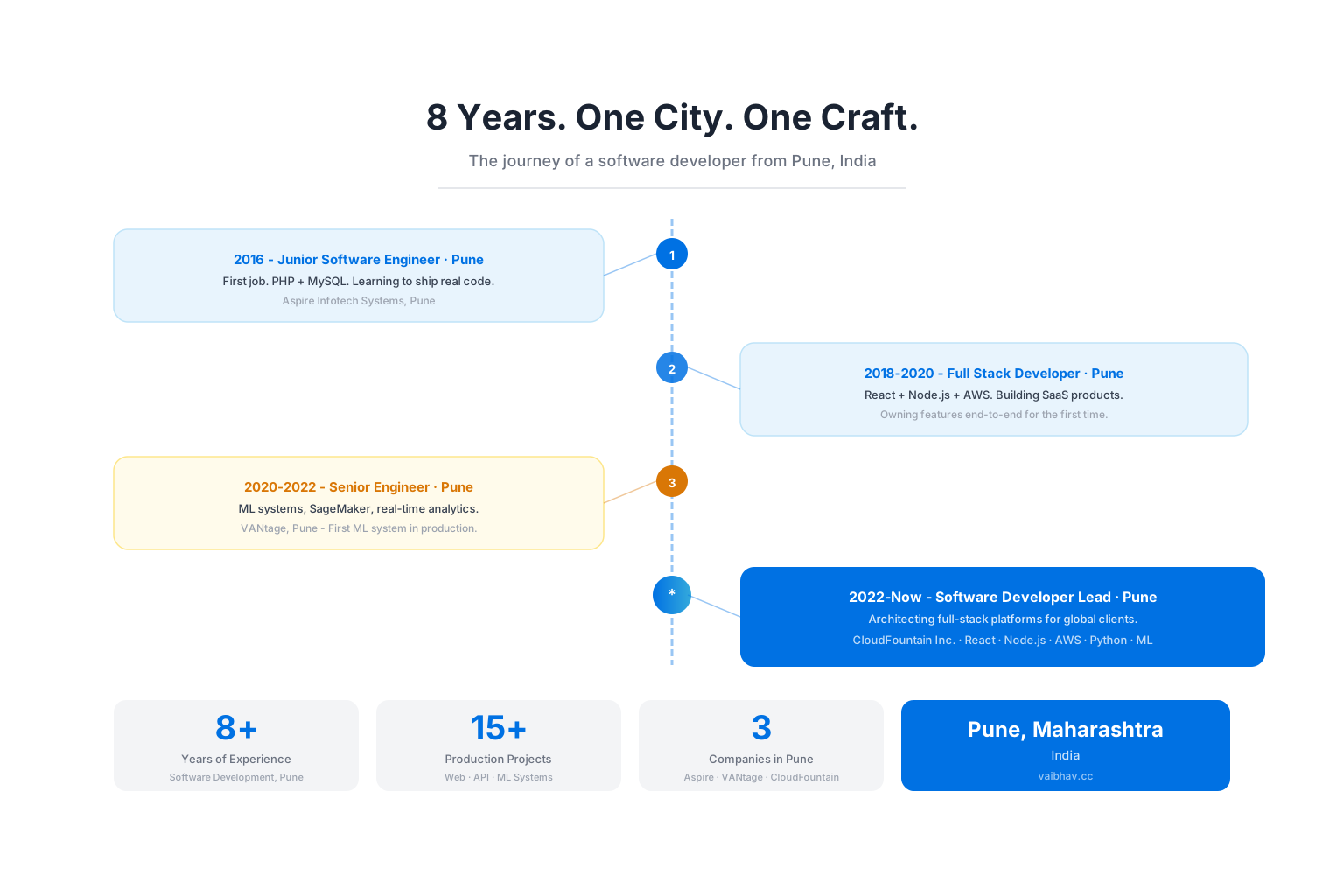
I did not plan to spend eight years in Pune as a software developer. I planned to stay two years and move somewhere bigger. But the work kept getting more interesting, the city kept improving, and the software engineering community here turned out to be far stronger than I expected when I started.
My name is Vaibhav Jadhav. I am currently a Software Developer Lead at CloudFountain Inc., where I architect full-stack web platforms, REST APIs, and machine learning systems for clients across the US and India. This post is a retrospective - what I built, what broke, and what being a software engineer in Pune actually looks like from the inside.
Where It Started: Pune, 2016
My first job as a software developer was at Aspire Techsoft Pvt. Ltd. in Pune. The stack was PHP and MySQL. The codebase had no tests. Deployments happened over FTP. I learned more in that first year than in the preceding four years of my engineering degree - because the problems were real, the deadlines were real, and the consequences of bugs were real.
Pune's software industry in 2016 was dominated by service companies and IT outsourcing. That has changed significantly. In the years since, I have seen more product companies, more funded startups, and more remote-first engineering teams establish a presence here. The city's software developer ecosystem is genuinely different now.
The companies with the best learning environments are not always the ones with the biggest names. At Aspire, a small software firm in Pune, I owned features end-to-end within six months. At a larger company, I might have spent a year on a single module. Ownership teaches faster than observation.
Moving Into Full Stack: 2018–2020
The shift from PHP to React and Node.js was uncomfortable and worth every bit of it. JavaScript everywhere - a frontend component talking to an API I also wrote, deployed on AWS infrastructure I also managed. For the first time I understood the system as a whole, not just my corner of it.
This is the phase where I became a software engineer in the broader sense: not just someone who writes code, but someone who understands how systems fail, how users behave differently than expected, and how the gap between a working demo and a stable production system is where most of the real engineering happens.
Pune gave me access to a strong React and Node.js hiring market. I was not competing with Bangalore salaries, but I was also not paying Bangalore rents. That balance - serious engineering work, reasonable cost of living - is genuinely underrated for someone trying to build deep technical skills without constant financial pressure.
Senior Engineering and the ML Shift: 2020–2022
At VANtage, a product company in Pune with US clients, I worked on my first machine learning system in production. Not a demo, not a Jupyter notebook - an actual lead scoring model running on AWS SageMaker, integrated into a sales pipeline, with real business decisions depending on its output every day.
That experience changed how I think about software engineering. ML systems introduce failure modes that pure software does not have: model drift, data quality regressions, prediction confidence thresholds. Debugging a production ML system is different from debugging a REST API, and the combination of both - a Python data pipeline feeding predictions into a Node.js API consumed by a React dashboard - is where I became confident operating across the full stack including the data layer.
You do not need a data science degree. You need production experience with Python, a solid grasp of the AWS ML toolkit, and the ability to evaluate model outputs critically — not just technically, but in terms of what the business actually needs. Most ML work at Indian software companies is applied engineering, not research. Treat it as such.
Software Developer Lead: 2022–Now
The title change to Software Developer Lead at CloudFountain happened gradually. I was already making architectural decisions, reviewing other engineers' code, and running technical client calls before the role was formalised. The lead role in software development is less about authority and more about accountability - you are the person who explains why the system is designed the way it is and owns the consequences when the design is wrong.
At CloudFountain, I work with a distributed team on client projects spanning React frontends, Node.js and Python backends, AWS infrastructure, and ML pipelines. The scope is broader than any role I had earlier in Pune, and the problems are correspondingly harder. Legacy code that cannot be rewritten overnight. Clients who change requirements mid-sprint. ML models that worked in staging and drifted in production.
Pune has been a competitive and practical base for this work. The timezone overlap with US clients is manageable (early morning calls), the technical hiring pool has improved significantly over the decade, and the infrastructure for remote software engineering - coworking spaces, fibre internet, a growing startup community - has matured.
What I Would Tell a Software Developer Starting in Pune Today
1. Choose depth over breadth early. Pick one stack - React + Node.js is a strong default - and go deep enough that you can explain how it works under the hood. Being able to debug a React re-rendering issue at the fiber level or trace a Node.js event loop bottleneck separates senior engineers from mid-level ones.
2. Ship things publicly. Contribute to open source, write on your blog, put personal projects on GitHub. In Pune's software market, your visible work matters as much as your resume. Recruiters and technical leads look at GitHub profiles and personal sites before interviews.
3. Learn at least one AWS service deeply. Not all of them - one. Understanding how Lambda works, how RDS handles connections under load, or how SageMaker deploys inference endpoints will make you a more valuable software engineer in any Pune company that serves non-Indian clients.
4. Pune is not a fallback city. The narrative that serious software engineers must move to Bangalore or Hyderabad is outdated. The work available in Pune - especially for engineers willing to work with US or EU clients remotely - is genuinely interesting and well-compensated. I have stayed, and I have not regretted it.
Eight years in, the thing I am most certain of is that software engineering rewards compounding. Every system you understand deeply makes the next one faster to learn. Every production incident you debug alone makes the next one shorter. The city matters less than the accumulation.
If you are a software developer or software engineer in Pune - or thinking of becoming one - and want to talk about the work, feel free to reach out on LinkedIn or through the contact section on vaibhav.cc.