You do not need a PhD to work with AI.
You need engineering discipline and the willingness to build.
Three years ago, I was a full stack developer working with React, Node.js, and AWS. I had zero formal machine learning background. Today, I architect and deploy ML systems at CloudFountain, including lead scoring models on AWS SageMaker, RAG pipelines with vector databases, and predictive analytics dashboards. The transition was not a career reset. It was an expansion of the same engineering skills I already had.
If you are a software developer wondering how to start with AI and machine learning, this is the roadmap I wish someone had given me. It is not academic. It is built around shipping working systems.
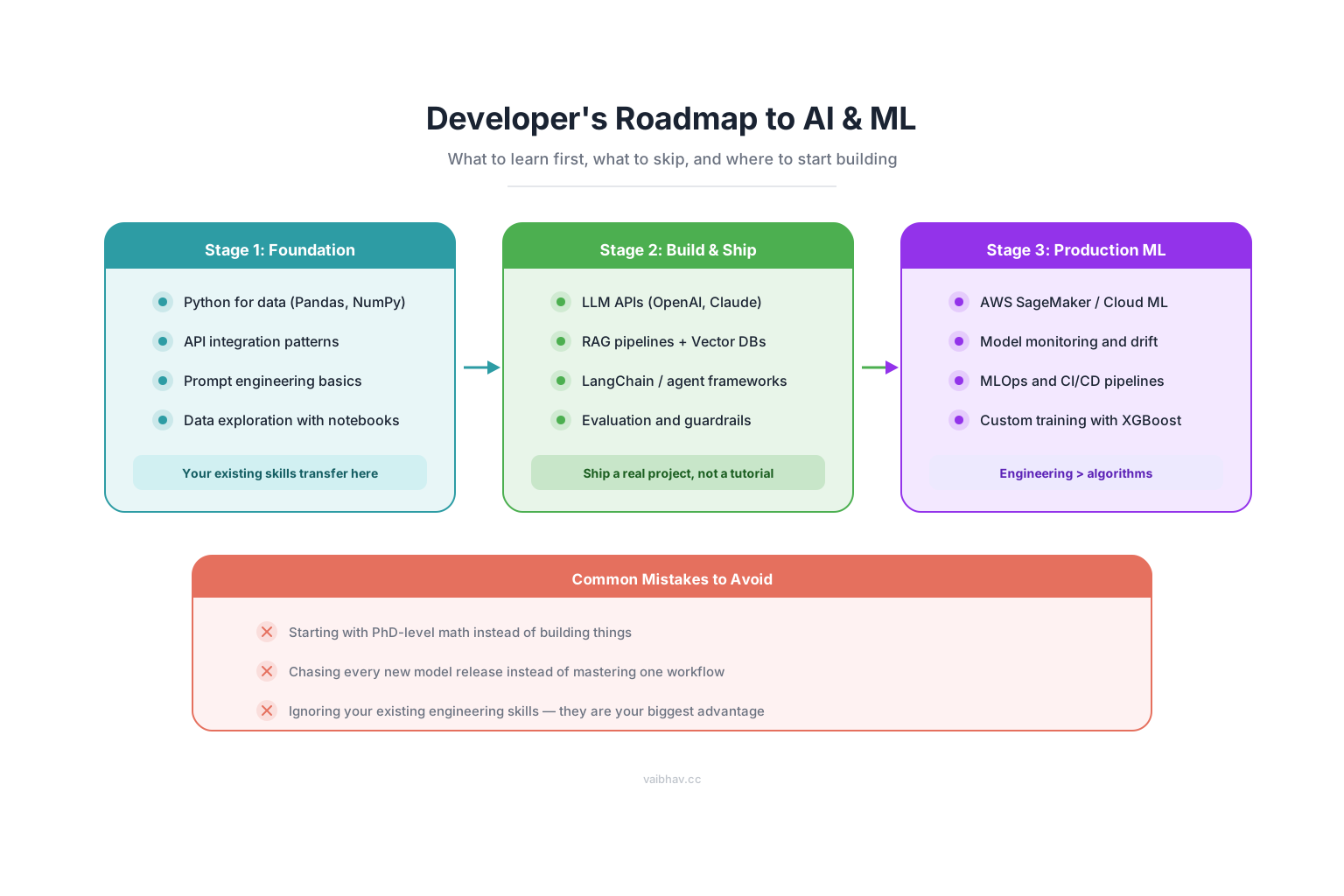
Stage 1: Your Existing Skills Are Your Biggest Advantage
The AI/ML space has a visibility problem. What gets attention on social media is novel research, new model architectures, and benchmark leaderboards. What actually matters in production is data pipelines, API design, deployment, monitoring, and error handling. Those are software engineering problems. You already know how to solve them.
If you already know JavaScript, Java, or any programming language, learning Python takes days, not months. Focus on the data libraries: Pandas for data manipulation, NumPy for numerical operations, and Matplotlib or Plotly for visualization. Skip the "learn Python from zero" courses. You already know how to code. Learn the libraries that matter for data work.
The fastest way to build something useful with AI is to call an LLM API. OpenAI, Anthropic Claude, and other providers offer APIs that work like any other REST service. If you have built integrations with Stripe, Auth0, or DocuSign, you can build an AI-powered feature. Build a chatbot for your documentation, a summarization tool for your team's meeting notes, or an automated email classifier. Ship it. The learning comes from the building.
Stage 2: Build Real Systems, Not Tutorials
Once you are comfortable calling LLM APIs, the next step is building systems that combine retrieval, generation, and your existing data. This is where Retrieval-Augmented Generation (RAG) comes in, and it is where software engineering skills matter enormously.
Take a dataset you actually care about: your company's documentation, a product knowledge base, or a collection of technical specs. Chunk it, embed it into a vector database like Pinecone or FAISS, and build a retrieval layer that feeds relevant context to an LLM. The tutorial version takes a weekend. The production version, with proper chunking strategies, hybrid search, caching, and stale data handling, takes weeks and teaches you more about AI systems than any course.
LangChain is useful for prototyping and it gives you a vocabulary for AI system components: chains, agents, retrievers, memory. But do not treat it as a black box. Understand what each component does at the API level. When your LangChain agent starts hallucinating or your retriever returns irrelevant results, you need to debug at the level below the abstraction. The developers who succeed with AI are the ones who understand the plumbing.
Stage 3: Production ML Is an Engineering Problem
If your goal is to train and deploy custom models, not just call APIs, you need cloud ML services. This is where I spent most of my growth at CloudFountain, moving from API-level AI features to building end-to-end ML pipelines on AWS SageMaker.
SageMaker Canvas and AutoML platforms like DataRobot let you train a model on your data without writing training code. This is not cheating. It is smart. You learn what data quality issues look like, how feature engineering affects outcomes, and what evaluation metrics mean for your business. Once you understand the problem space, move to SageMaker notebooks with XGBoost or scikit-learn for more control. The progression from no-code to low-code to custom code is the fastest learning path.
In my experience, 70% of production ML work is data preparation: cleaning, joining, feature engineering, and handling edge cases. 15% is training and evaluation. 15% is deployment, monitoring, and retraining. The algorithm choice (XGBoost vs. random forest vs. neural network) matters far less than the data quality and the engineering around the model. This is where software developers have a natural advantage.
What to Skip (for Now)
Deep learning theory. Unless you are doing computer vision or NLP research, you do not need to understand backpropagation at a mathematical level to build production AI systems. Learn it when you hit a problem that requires it.
Every new model release. A new LLM drops every week. Chasing each one teaches you nothing. Pick one model family, understand its capabilities and limitations deeply, and build real systems with it. Transfer that knowledge when a genuinely better option emerges.
The hype cycle. Ignore predictions about "AGI timelines" or which jobs will "disappear." Focus on building things that work today. The developers who are thriving in AI are not the ones who predicted the future correctly. They are the ones who built useful things with the tools that exist right now.
The best time to start with AI was two years ago. The second best time is now, and your engineering background is the fastest on-ramp that exists.
I started this journey as a React and Node.js developer. Today I build ML systems, RAG pipelines, and predictive models alongside the full stack applications that consume them. The transition was not about abandoning my existing skills. It was about applying them to a new problem domain. If you can build a production web application, you can build a production AI system. The engineering is the same. The domain is different.